
Multi bets in New Zealand — what they cost, what they pay, and who is allowed to take them
 Available in US
Updated as of 31 October 2026 and checked against the Department of Internal Affairs register and TAB NZ’s published betting rules.
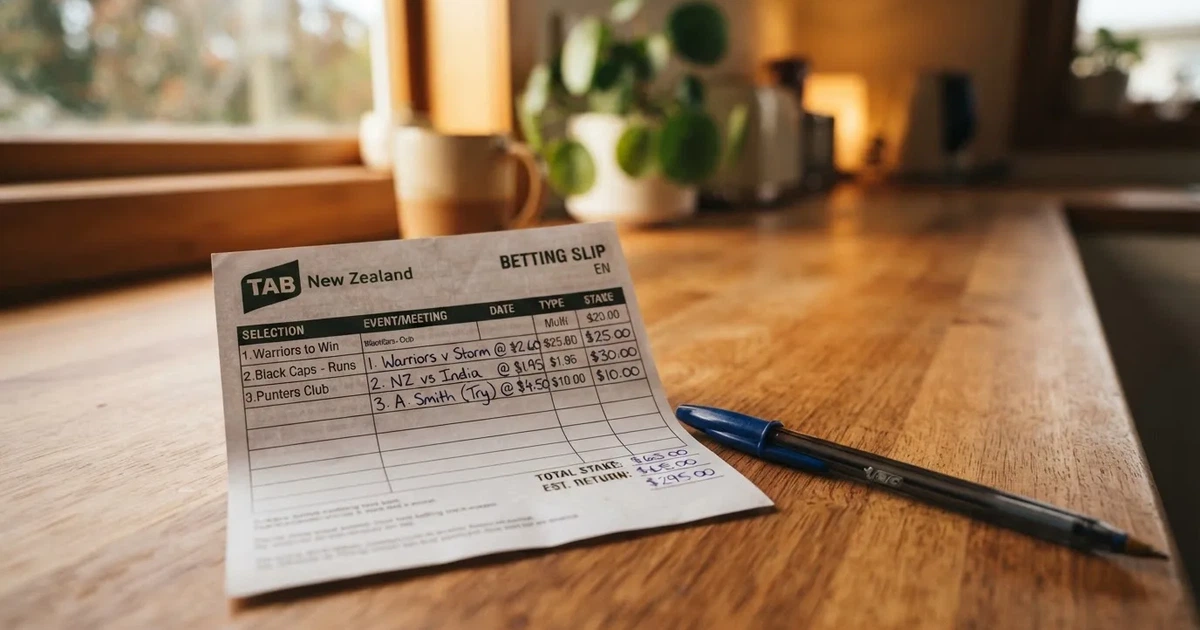
A multi bet — known to a New Zealand punter as a multi — links two or more single selections into one wager. The whole ticket wins only if every leg wins, and a single push or loss on any leg drops the payout to zero. The attraction is the price: each leg’s decimal odds multiply into one combined price, and a $10 stake on three selections at 1.50, 2.00 and 2.50 returns $75 if all three win. The catch lives in the multiplication itself — the longer the chain, the larger the number printed on the slip, and the rarer the event that every leg lands together.
New Zealand in 2026 runs this market on a single national footprint. TAB NZ, and its online sister brand Betcha, are the only operators lawfully allowed to take racing and sports bets from a person in New Zealand. That restriction was written into the Racing Industry Act 2020 by an amendment that took effect on 28 June 2025, and it shapes what a multi bet costs here, who profits from it, and where a player turns when a dispute arises.
What the law now says about who can take a multi bet
The Racing Industry Act 2020 and section 74AAA
Section 74AAA of the Racing Industry Act 2020 — inserted by the Racing Industry Amendment Act 2025 and in force since 28 June 2025 — prohibits any person other than TAB NZ from offering racing betting, sports betting, or other racing or sports betting to a person in New Zealand, regardless of where the operator is resident or incorporated. The Department of Internal Affairs told unlicensed providers serving New Zealand customers to withdraw with immediate effect on that date. There is no licence to apply for, because there is only one lawful provider.

TAB NZ is not a private operator in the conventional sense. The racing industry owns it, and the New Zealand Racing Board is its statutory holder. Entain runs the TAB business under a 25-year agreement signed in 2023 that splits gross profits 50/50 and commits Entain to at least $150 million a year to TAB NZ for the first five years, with a one-off $100 million payment to the racing sector on signing. TAB NZ’s two online brands, TAB and Betcha, sit under that single operator group and are never rivals in the way two bookmakers might be.
What the ban covers, and what it does not
The prohibition applies to racing and sports betting offered to people in New Zealand. Bets on events held inside New Zealand and bets on events held outside the country are both covered. Greyhound racing is closing in stages from 1 August 2026, and from that date offshore operators may not take bets on greyhound races either. The Online Casino Gambling Act 2026 licenses online casino gambling only; it does not extend TAB NZ’s monopoly on sports or racing betting, and TAB NZ’s right to apply for a casino licence does not move that line.

Nothing in the section states a penalty for the player who places a bet with an offshore operator. Section 19(4) of the Gambling Act 2003, inserted in 2025, says an individual may not be convicted for placing a bet with an offshore operator in breach of section 74AAA. The penalty sits with the operator. DIA warns players that offshore operators may be in jurisdictions with minimal consumer safeguards, may not return unspent credits, and may not pay out large wins.
What this means at the betting slip
For a New Zealand punter the practical shape is simple. The lawful path is TAB and Betcha, both of which carry a multi bet product and a same-game multi product. Anything else — every crypto sportsbook, every Curaçao-licensed brand, every bookmaker advertised in another market — sits outside the section 74AAA framework. The site loads, the slip accepts the bet, and no New Zealand complaints route reaches it. That is the trade a player is making when they place a multi bet offshore.
How a multi bet is built and settled
The basic structure
A multi bet links two or more individual wagers, called legs, into a single wager. Each leg is a normal fixed-odds bet, with its own stake and its own price. The combined price is the product of the legs. A two-leg multi at 1.80 and 2.20 returns the stake times 1.80 times 2.20; a three-leg multi at those prices times a third leg multiplies again. There is no cap on the number of legs a bookmaker will accept — TAB NZ’s online slip lets a punter stack more — but every added leg is one more event that has to win.
The bet wins if and only if every leg wins. One losing leg loses the whole bet, regardless of how many legs will otherwise land. The bet ties, in whole or part, if one of its legs ties: a push on one leg removes that leg from the ticket and the combined odds reduce to the product of the remaining selections, while a push on every leg reduces to a single winner and pays out at the combined reduced price. New Zealand punters see the same mechanic described in TAB NZ’s published betting rules under Multis and Same Game Multis.
Same-game multis
A same-game multi takes its legs from one event. The classic example is an All Blacks test where one leg is the match result, a second is the total points line, and a third is a first-tryscorer market — all from the same fixture. The product of the legs becomes the price, just as in a regular multi, but the bookmaker’s pricing constraint is tighter: the legs are correlated, and a correct line on the total affects the likelihood of a winning margin. TAB NZ’s same-game multi product lists player performances, team totals and match-result combinations on rugby, league and football fixtures.
Why the price looks the way it does
Each leg carries the bookmaker’s margin — the slice of every dollar staked bet that the operator keeps on average across the market. A 5% margin on a binary market gives a payout share of 95%, so a fair two-outcome price of 1.90/1.90 becomes 1.86/1.86 once the margin is loaded. A multi bet compounds the margin leg by leg. Three legs each at a 5% margin, expressed honestly, give a combined price roughly 14% smaller than the product of the true probabilities will suggest — and that is on a market where the legs are independent. Same-game multis compound the problem because the legs are not independent, and the price reflects that. A multi bet is never “free money”; the longer the chain, the larger the gap between the printed price and the true odds of every leg landing together.
Full cover bets and the system beyond the simple multi
A simple multi is one ticket, every leg must win. A full cover bet — Trixie, Yankee, Heinz, Super Heinz and the rest — wraps a fixed set of selections in every combination. A Trixie on three selections is four bets: three doubles and a treble. A Yankee on four selections is eleven bets. A Heinz on six selections is fifty-seven. A Super Heinz on seven is one hundred and twenty. The legs do not all need to win; the punter needs enough combinations to land to cover the stake and turn a profit. These structures cost more than a single multi because the stake multiplies across the combinations, but they soften the all-or-nothing blow of a single late leg going down.
The money: how a multi bet pays out
Decimal odds and the arithmetic
TAB NZ publishes its odds in decimal form, written as $2.10 for a price that returns $2.10 for every $1 staked, including the $1 stake. The arithmetic for a single bet is return = stake × odds; net profit is stake × (odds − 1). For a multi bet the odds of the legs multiply into one combined price, and that combined price is what multiplies the stake.
Worked example with a $10 stake on three selections at 1.50, 2.00 and 2.50 — illustrative prices, not quoted odds:
- Combined price = 1.50 × 2.00 × 2.50 = 7.50
- Return = $10 × 7.50 = $75 (including the $10 stake)
- Net profit = $10 × (7.50 − 1) = $65
The band to remember: with three selections between 1.50 and 2.50 and a $10 stake, a winning multi returns somewhere in the $37.50 to $125 range, the low end from three short-priced favourites and the high end from three longer shots. The shape of the result follows from the multiplication, and the multiplication is what makes a multi look expensive on the slip.
How a same-game multi pays
A same-game multi follows the same rule, with the combined price being the product of the legs and the return being the stake times that product. The pricing constraint is the legs’ correlation, and a same-game multi on an All Blacks test at $5.50 might be lower than a regular multi of equivalent-looking legs precisely because the bookmaker is pricing the correlation. TAB NZ’s same-game multi slip shows the combined price live as legs are added, and the punt is settled at that printed combined price.
What the margin does to the payout
The bookmaker’s margin sits inside each leg’s price, so it sits inside the combined price, and it sits inside the payout. Three legs at 1.50, 2.00 and 2.50 with no margin will multiply to 7.50, but those numbers carry margin in them. A five-per-cent margin on each leg, on independent markets, gives a combined fair price closer to 6.45 than to 7.50. The $10 stake returns $64.50 instead of $75 in that scenario — a $10.50 gap between the printed payout and what a margin-free market will yield. That is the cost a New Zealand punter pays for the privilege of multiplying the legs together.
TAB NZ’s two brands and the multi bet product
TAB
TAB is the legacy brand of the TAB NZ group, run by Entain under the partnership described above. The mobile app, “TAB – Racing & Sports Betting”, is published on the New Zealand App Store under the seller name New Zealand Racing Board and was first released on 8 September 2014. The app carries fixed-odds and pool (tote) betting, racing and sports, and Multis and Same Game Multis sit alongside the single-event markets. The app includes safer-gambling tools — deposit limits, time-outs and self-exclusion — and an exclusion applies across both TAB NZ brands.
The bookmaker’s edge is the standard fixed-odds margin loaded into every leg of every multi. There is no published per-leg margin for the multi market, because the multi is a product built on top of single-event markets whose own margins are not publicly broken out. The combined price reflects the compounded margin, and a punt is settled at the price printed on the slip at the time of placement.
Betcha
Betcha is the second TAB NZ brand, aimed at a younger audience than the legacy TAB app and pitched around community features. Its app carries a daily Toolbox with odds boosts and insurance tools for bets that do not land, a Bet Social section where punters chat, follow tipsters and share bets or pools, and a Playbook with tips and match analysis. The same multi bet product is available under the same TAB NZ operator, the same licensing frame, and the same safer-gambling tools.
What separates Betcha from TAB in the comparison is the social layer and the daily Toolbox, not the multi bet pricing. The combined price on a multi is the same product, the same margin, and the same settlement rule. A punter choosing between them is choosing between two product surfaces over the same underlying bookmaker — the older, racing-led TAB app or the more social, sport-led Betcha experience.
Offshore brands New Zealand players meet
The brands below do not hold a New Zealand licence, because section 74AAA does not provide one to apply for. They are listed here because New Zealand players meet them in search results, in affiliate pages, and in recommendation lists written for other markets. Each is judged by the same criteria — what its multi bet product looks like, what its terms say, and what a New Zealand player gains or loses by using it. None of them is lawful to take a New Zealand bet under section 74AAA.
Telbet
Telbet is a crypto casino and sportsbook. Its Russian-language welcome offer is a 200% match up to 1 BTC plus 50 free spins and a 5 USDT free bet. The multi bet product is the standard accumulator across the sportsbook’s fixture list, and the combined price follows the same multiplication as anywhere else. What a New Zealand punter gives up by using Telbet is the New Zealand harm-minimisation framework — no deposit limit enforced through TAB NZ’s app, no cross-brand self-exclusion, no recourse to DIA. The crypto rails and the offshore licence mean the bet is settled under Telbet’s house rules, in Telbet’s jurisdiction, with whatever consumer protection that licence happens to carry.
BetAlright
BetAlright accepts customers over 18 only and runs a separate partners site. The multi bet product is a standard sportsbook accumulator on football and the major international leagues. Nothing in its terms names a New Zealand licence, and the brand sits outside the section 74AAA framework. New Zealand players face the same trade-off they face at every offshore brand on the list: the slip accepts the bet, the offshore operator takes it, and no New Zealand complaints route reaches it.
BigClash
BigClash offers pre-match and live sports betting across international and local leagues, plus virtual sports and esports betting on FPS and MOBA titles. Its licence is a Curaçao licence (8048/JAZ), which gives no right to take bets from people in New Zealand. The multi bet product is the standard accumulator across the sportsbook menu, and the combined price carries the same compounded margin that every bookmaker loads into a multi. The Curaçao licence is the regulatory frame the operator runs under; it is not a New Zealand licence.
BillyBets
BillyBets offers three odds formats — Decimal (2.00), American (+100) and Fractional (1/1) — so a New Zealand punter used to decimal odds can keep the slip readable. The multi bet product is a standard sportsbook accumulator across football, basketball, tennis and the usual menu. The brand names no licence that applies in New Zealand, and the same offshore trade-off applies.
Spinbara
Spinbara advertises a first-deposit bonus of 100% up to EUR 100 on its sportsbook, a sport crypto welcome bonus of 100% up to 200 USDT, and a separate casino welcome bonus of 100% up to EUR 500 plus 200 free spins. The sportsbook carries a standard multi bet product; the offshore terms apply. The bonus figures are large because the offshore market prices bonuses to compete; what those bonuses cost the punter in turnover, minimum price and expiry is in each offer’s own terms, and reading them is the difference between a bonus and a marketing line.
Rabona
Rabona launched on 23 December 2019 as the sixth online sportsbook of the Soft2Bet group. It runs on a Curaçao licence, which gives no right to take bets from people in New Zealand. The multi bet product is a standard accumulator across the Soft2Bet sportsbook menu. The combination bet structures (Trixie, Yankee and the rest) are available, and the same combined-price mechanic applies.
Roobet
Roobet is a brand of Raw Entertainment B.V., registration number 157205, Korporaalweg 10, Curacao, licensed under Curaçao licence OGL/2024/687/0427. The multi bet product is a standard accumulator across its sportsbook, and the same compounded margin sits inside every leg. The Curaçao licence is the only frame under which Roobet settles a bet from a New Zealand player, and there is no New Zealand complaints route.
FunBet
FunBet’s sportsbook offers odds on football, ice hockey, American football, basketball, volleyball, tennis, rugby and baseball, with live betting and a bookmaker described as open 24/7. The multi bet product is a standard accumulator across that menu. The brand names no licence that applies in New Zealand, and the offshore trade-off applies.
How multi bets in New Zealand compare: the shortlist
The table below sets the landscape side by side. Status reflects who may lawfully take a bet from a person in New Zealand under section 74AAA of the Racing Industry Act 2020; “TAB NZ brand” means the operator is one of the two online brands of TAB NZ and runs the bet inside the New Zealand framework. The third column carries what each operator’s own terms state on the multi bet subject — the kind of multi product available, the price format, and any feature that materially affects a multi bet.
| Brand | New Zealand status | What the operator’s own terms state on multi bets |
|---|---|---|
| TAB | TAB NZ brand | Fixed-odds and pool betting; Multis and Same Game Multis; decimal odds; safer-gambling tools in the app |
| Betcha | TAB NZ brand | Multis and Same Game Multis; daily Toolbox with odds boosts and insurance; Bet Social with shared bets; decimal odds |
| Telbet | Not licensed in New Zealand | Sportsbook accumulator; crypto rails; 200% welcome bonus up to 1 BTC plus 50 free spins and 5 USDT free bet |
| BetAlright | Not licensed in New Zealand | Sportsbook accumulator; 18+ customers only; separate partners site |
| BigClash | Not licensed in New Zealand | Sportsbook accumulator; pre-match and live; Curaçao licence 8048/JAZ |
| BillyBets | Not licensed in New Zealand | Sportsbook accumulator; Decimal, American and Fractional odds formats |
| Spinbara | Not licensed in New Zealand | Sportsbook accumulator; 100% up to EUR 100 first-deposit bonus; 100% up to 200 USDT crypto welcome |
| Rabona | Not licensed in New Zealand | Sportsbook accumulator; Curaçao licence; Trixie, Yankee and full cover structures available |
| Roobet | Not licensed in New Zealand | Sportsbook accumulator; Curaçao licence OGL/2024/687/0427; brand of Raw Entertainment B.V. |
| FunBet | Not licensed in New Zealand | Sportsbook accumulator; pre-match and live; football, ice hockey, basketball, tennis, rugby, baseball |
What the table does not say is what a multi bet actually costs the punter. The compounded margin sits inside every leg of every multi, on every brand, and it compounds further on a same-game multi because the legs are correlated. The lawful-New Zealand brands and the offshore brands compete on the same arithmetic; what separates them is the framework around the bet, not the price on the slip.
Choosing the right path
The lawful path: TAB or Betcha
For a New Zealand punter who wants the bet inside the New Zealand framework — DIA oversight, harm-minimisation tools, cross-brand self-exclusion, a complaints route that reaches a New Zealand body — the choice is between the two TAB NZ brands. TAB carries the racing-led product, the pool (tote) markets, and the legacy app. Betcha carries the same multi bet product under a more social interface, with a daily Toolbox of odds boosts and insurance and a Bet Social layer for sharing bets and following tipsters. The multi bet pricing is the same product, and the choice is one of surface, not of edge.
The trade-off inside this path is the product itself. TAB NZ’s multi bet is a fixed-odds accumulator with the same compounded margin every bookmaker loads into a multi. The longer the chain, the larger the printed price, and the rarer the event that every leg lands together. A punter who treats a multi as a small-stake lottery ticket — $2 or $5 across a long-shot chain, with the understanding that most chains lose — gets the product it is. A punter who treats a multi as a serious betting instrument reads the slip for correlated legs, watches the combined price, and accepts that the compounded margin is the cost.
The offshore path: Telbet, BetAlright, BigClash, BillyBets, Spinbara, Rabona, Roobet, FunBet
For a New Zealand punter who ends up at an offshore brand, the choice is the offshore market itself: crypto sportsbooks, Curaçao-licensed books, and brands with no licence that applies in New Zealand. The slip accepts the bet, the combined price is competitive by international standards, and the bonus offers are large. What that punter gives up is the New Zealand framework — no DIA oversight, no New Zealand harm-minimisation tools, no cross-brand self-exclusion, no complaints route that reaches a New Zealand body. DIA’s standing warning is that offshore operators may be in jurisdictions with minimal consumer safeguards, may not return unspent credits, and may not pay out large wins.
The trade-off inside this path is consumer protection versus product breadth. Offshore brands often offer a wider pre-match menu and a deeper live betting product than TAB NZ’s app, and they sometimes run odds-boost promotions that look generous. The price on the slip is not the price the punter keeps; the offshore settlement framework is.
How a punter decides
A punter who bets a small amount occasionally, on a multi bet they understand, and who wants the bet inside the New Zealand framework, must use TAB or Betcha. A punter who bets through a serious staking plan, who reads each leg’s price and watches the combined price, and who accepts the New Zealand framework, is the same answer. A punter who wants a product the New Zealand framework does not carry, who understands the offshore trade-off, and who can afford to lose what they stake, may use an offshore brand — but they must know that the bet is unlawful on the operator side, that DIA warns against it, and that the consumer protection comes from the offshore licence, not from New Zealand law.
Responsible gambling tools and where to get help
TAB NZ’s app provides deposit limits, time-outs and self-exclusion, and an exclusion applies across both TAB NZ brands (TAB and Betcha). The age for TAB NZ betting is 18 (betting under 18 is an offence under section 89 of the Racing Industry Act 2020); land-based casinos are 20 — never merge the two. TAB NZ must keep the risks of problem and underage gambling minimised and pays a Problem Gambling Levy of 0.74%, in force from 1 July 2025 to 30 June 2028.
The free Gambling Helpline is 0800 654 655, with a text line at 8006. Safer Gambling Aotearoa is the public-facing service. There is no single national online-betting exclusion register; the register the Online Casino Gambling Act 2026 will require is for online casinos only. For offshore brands, none of these tools is enforced, and self-excluding at TAB NZ does not reach the offshore account. A punter who wants to step back has to step back at every brand they use.
What a multi bet really costs: the arithmetic of compounding
A multi bet is a product on top of a single-event market, and the price on the slip reflects the compounded margin leg by leg. A two-leg multi at 1.80 and 2.20, with each leg carrying a 5% margin, returns the stake times a combined price that is roughly 8% smaller than the product of the true probabilities will suggest. A three-leg multi at 1.50, 2.00 and 2.50, with the same margin assumption, returns the stake times a combined price roughly 14% smaller than the product of the true probabilities. The shape of that gap grows with the chain. It is the single most important number on a multi bet slip, and it is not printed anywhere on the slip itself.
The corollary is that a multi bet pays back less than its printed price implies, on average, across many bets. A $10 stake on three selections at 1.50, 2.00 and 2.50 returns $75 if all three win — but the combined price carries margin in it, and the same selection at the true probabilities will have multiplied to a higher combined price. The expected return of a multi bet, averaged across many tickets, is the stake times the compounded payout share, and the compounded payout share is the product of the individual payout shares. A punter who treats a multi bet as a regular betting instrument must expect to lose the margin, on average, every time they place one.
What this page is for
This page describes how a multi bet is built, settled and paid out in New Zealand in 2026, and what each of the brands a New Zealand punter meets charges for the privilege. It does not recommend a brand, a stake, a chain, or a strategy. The compounded margin sits inside every leg of every multi, on every brand, and the price on the slip is the price the punter keeps. TAB and Betcha are the only lawful option; offshore brands are lawful-or-not depending on the operator, unlawful under section 74AAA for the operator side, and outside the New Zealand harm-minimisation framework. The reader’s job is to read the slip, read the terms, and decide which trade-off matches the bet they want to place.
Frequently asked questions
How are multi bets calculated?
A multi bet’s return is the stake multiplied by the product of the decimal odds of every leg. A $10 stake on three legs at 1.50, 2.00 and 2.50 returns $75 if all three win — combined price 7.50, stake $10. The same arithmetic applies whether the multi is a regular multi across different events or a same-game multi whose legs all come from one fixture.
How do multi bets work?
A multi bet links two or more single wagers, called legs, into one ticket. The ticket wins if and only if every leg wins; one losing leg loses the whole bet. If one leg ties (a push), that leg is removed and the combined odds reduce to the product of the remaining selections, while a push on every leg reduces to a single winner at the combined reduced price.
How does multi bet work?
A multi bet is a single fixed-odds wager whose price is the product of the prices of its legs. The stake is returned only on a win; a losing leg drops the payout to zero. TAB NZ’s published betting rules describe Multis and Same Game Multis under the same product, with a same-game multi taking all of its legs from one event.
What is a multi bet and how does a same-game multi differ from it?
A multi bet is a single wager linking two or more selections, with the combined odds being the product of the legs. A same-game multi is a multi whose legs all come from one event — an All Blacks test where the legs are match result, total points, and first tryscorer, for example. The same combined-price arithmetic applies, but the bookmaker’s pricing is tighter because the legs are correlated.
How is the return on a bet worked out from the stake and the odds?
Return = stake × odds. Net profit = stake × (odds − 1). At decimal odds of 2.10, a $10 stake returns $21 ($11 profit); at 1.50, a $10 stake returns $15 ($5 profit). For a multi bet the odds in those formulas are the combined price — the product of the legs.
How are decimal odds such as 2.10 turned into a return?
Decimal odds already include the stake. The arithmetic is return = stake × decimal odds. A $10 stake at 2.10 returns $21 ($11 net profit); a $10 stake at 1.50 returns $15 ($5 net profit). For a multi bet, multiply the legs first to get the combined price, then multiply the combined price by the stake.
Tips & strategy – dogracingnz.com
Content created by the «dogracingnz.com» team
