
Rugby union betting in New Zealand
 Available in US
Current as of 31 October 2026 and checked against the Department of Internal Affairs register and TAB NZ’s published terms.

In New Zealand, betting on rugby union runs through a single lawful channel. TAB NZ and its online sister brand Betcha are the only operators permitted to take online sports and racing bets from a person in New Zealand, by force of section 74AAA of the Racing Industry Act 2020 since 28 June 2025. Every other bookmaker a New Zealand punter meets online is operating unlawfully so far as New Zealand law is concerned, even when it carries an offshore licence from Curaçao, Anjouan or Tobique. That single fact shapes everything on this page: what a player can legally do, what harm-minimisation framework actually reaches them, and which of the ten brands reviewed below carry the protections the regulator can enforce.
The legal position: TAB NZ’s monopoly and what it means for the punter
The Racing Industry Act 2020 establishes TAB NZ as the sole betting provider for racing and sports in New Zealand, and the Racing Industry Amendment Act 2025 closed the loophole that let offshore brands serve New Zealand residents. The new section 74AAA, in force from 28 June 2025, says no person other than TAB NZ may offer racing betting, sports betting or other racing or sports betting to a person in New Zealand, regardless of where that operator is resident or incorporated. The Department of Internal Affairs told unlicensed providers serving the market to withdraw with immediate effect when the change took effect.

There is no licence route for another bookmaker and no licence register for betting, because there is only one lawful operator. The law does not geo-block offshore websites; it puts liability on the operator. New Zealand does not write an offence for the player placing the bet — section 19(4) of the Gambling Act 2003, inserted in 2025, says an individual may not be convicted for placing a bet with an offshore operator in breach of section 74AAA — but the Department warns that overseas operators may sit in jurisdictions with minimal consumer safeguards, may not return unspent credits, and may not pay out large wins.
TAB NZ itself runs under a 25-year partnership signed with Entain in 2023. Entain operates the TAB business and shares gross profits 50/50, with at least $150m a year flowing to TAB NZ for the first five years, plus a one-off $100m payment to the racing sector from Entain. The two online brands, TAB and Betcha, are the same operator group, never rivals. Betcha was first released on the New Zealand App Store on 6 August 2024 by Entain New Zealand Limited and covers horse, greyhound and harness racing plus rugby, NRL, MMA/UFC, NBA, NFL, tennis, cricket, football, motorsports and esports.
For the player, the practical shape of the monopoly is this. A bet placed with TAB or Betcha carries New Zealand harm-minimisation tools, regulator oversight and a complaints framework. A bet placed with an offshore brand carries none of those: no New Zealand complaints route, no deposit-limit mechanism the Department can enforce, no obligation on the operator to pay out under New Zealand consumer law. None of that makes offshore betting illegal for the individual who places the bet, but it does mean there is no one in New Zealand the punter can complain to when an offshore operator simply declines to pay.
The Racing Industry Act also touches what may be bet on. Greyhound racing is closing in stages from 1 August 2026, and from that date offshore operators may not take bets on greyhound races either. The ban covers events held inside and outside New Zealand. The Online Casino Gambling Act 2026 licenses online casino gambling only and does not extend the TAB NZ monopoly in either direction — TAB NZ winning the right to apply for a casino licence does not let it, or anyone else, take bets the Act says only TAB NZ may take.
A small footnote on the casino-versus-betting distinction. The minimum age for TAB NZ betting is 18; section 89 of the Racing Industry Act 2020 makes betting under 18 an offence. Land-based casinos in New Zealand are 20. The two ages are never merged, and an account opened at TAB NZ requires a verified New Zealand address and ID.
What the regulator can and cannot reach
The Department of Internal Affairs monitors compliance with the betting prohibition under the Racing Industry Act 2020, section 92A, but the published record does not name a prosecution of an offshore bookmaker since 28 June 2025. The penalty for breaching section 74AAA is not stated in the section itself. The Department’s enforcement is real but its published actions are statements and withdrawal demands rather than convictions listed in a public register.
On the advertising side, the Advertising Standards Authority’s Gambling Advertising Code applies to betting advertisements: ads must not target children under 14 or young people from 14 to under 18, judged by context, appeal and expected audience (an audience of 25% or more young people counts as significant where accurate data exists), must not encourage harm, and must be truthful with terms available. No New Zealand equivalent of a “whistle-to-whistle” broadcast ban was found. TAB NZ runs “bonus bets” promotions; no New Zealand rule on bonus-bet size or wagering terms was found, so any figure on bonus terms comes only from TAB NZ’s own conditions.
The tax picture, in two lines
Recreational gambling winnings are generally not taxable for the player under Inland Revenue guidance, and prize money from TAB horse, dog and trotting races is not taxable. A person who bets as a business is a different case and the relevant guidance is general information rather than tax advice. On the operator side, TAB NZ pays the Problem Gambling Levy of 0.74% (in force from 1 July 2025 to 30 June 2028), and overseas operators supplying New Zealand residents pay online gambling duty of 12% of profits since 1 July 2024, rising to 16% from 1 January 2027. A duty being payable does not make an offer lawful; the page never writes that tax payment shows a bookmaker is legal. The point-of-consumption charge on offshore racing and sports bets ceased on 30 June 2026.
Safer gambling: what the framework actually gives a New Zealand punter
The legal monopoly has a practical upside the offshore market cannot match: harm-minimisation tools that the regulator can enforce. TAB NZ’s app lists deposit limits, time-outs and self-exclusion, and an exclusion applies across both TAB NZ brands. The age floor is 18, and the account-opening process requires a New Zealand address and identity check — a real friction, and the kind of friction that tends to keep the lowest-budget and youngest users out of the market.
The free Gambling Helpline (0800 654 655, text 8006) is the front door for anyone worried about their own betting or someone else’s. Safer Gambling Aotearoa sits alongside it as the public-facing harm-prevention programme. The Problem Gambling Levy funds those services at 0.74% of TAB NZ’s relevant revenue, and the levy is in force from 1 July 2025 to 30 June 2028.
There is no single national online-betting exclusion register. The register the 2026 online casino law will require is for online casinos only and does not reach a TAB NZ or Betcha account. A punter who self-excludes at TAB NZ is excluded across both TAB NZ brands; a punter who opens an account at an offshore brand has no equivalent single switch.
For a punter comparing options, the test is whether the operator’s safer-gambling framework is enforceable by someone the punter can actually reach. TAB NZ’s tools sit inside a regulator that monitors compliance. The offshore brands reviewed further down have a stated harm-minimisation programme of their own, but it sits outside the Department of Internal Affairs’ reach and there is no New Zealand complaints route if a dispute arises.
Predictions, tips and the limits of “rugby union betting tips”
The search for “rugby union betting tips” or “free rugby union betting tips” returns a market of tipsters, model-based forecasts and social channels, and the page describes what those services are and what they cost. None of them can know an outcome. A tip is one person’s forecast, published with no liability if it loses. A subscription model aligns the tipster’s revenue with selling more tips, not with the punter’s bottom line. Free tips carry the same problem and sell the punter’s attention to advertising in exchange.
What a punter can do with a forecast is treat it as one input among several. The form of the two teams in the last four games, the venue, the head-to-head, injuries to key positions (first five-eighth, props, captain), the ladder position in Super Rugby Pacific, the referee’s penalty history — these are the things a tipster assembles. The market outcome is the bookmaker’s odds, which already bake in much of that information. Where the punter’s edge exists, it tends to come from a specific angle a market has underweighted: a wet-weather game in which the line is set for dry conditions, a team returning from a long tour, a back-row contest between two specific players.
Two practical limits. First, the bookmaker’s margin sits inside every price, and a tip that picks the winner at shorter odds than the true probability still loses the punter money over a season. Second, no tip survives variance — a four-leg multi at combined odds of 20.00 pays beautifully on the rare win and bleeds the punter’s bankroll across the misses. Bankroll discipline is the only mechanism that turns forecasting into a sustainable activity, and the activity still goes wrong more often than not.
The closer a tip comes to a “sure” bet, the more it is to be treated as marketing. The closer it comes to a paid subscription, the more the punter is buying the social proof of a tipster’s track record than any predictive edge. Neither survives scrutiny, and the page records both because both meet a New Zealand punter searching the topic.
Bet types and odds: how rugby union prices are built
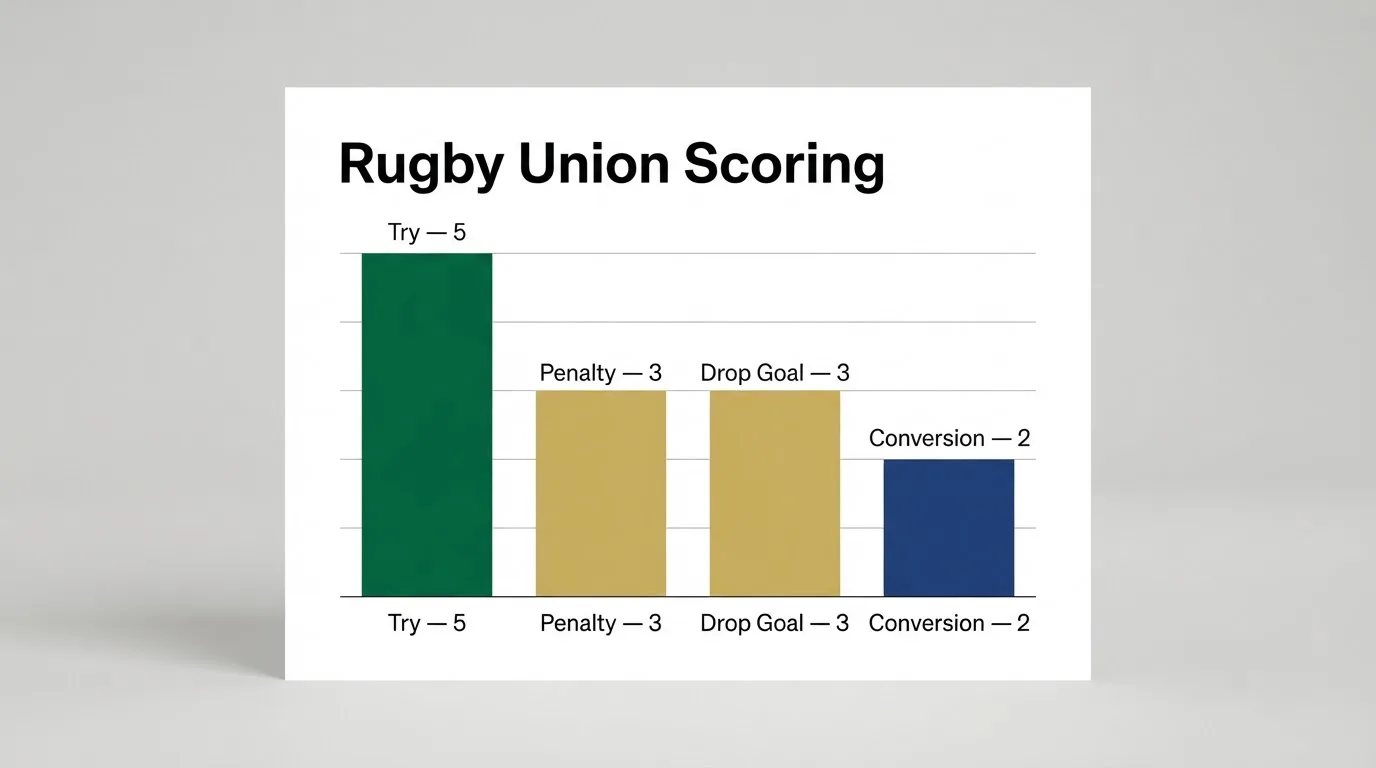
Rugby union is a low-scoring game, and the markets that survive are those that handle that. A 5-point try, a 2-point conversion, a 3-point penalty and a 3-point drop goal make the margin of victory meaningful in a way football’s scores are not. The handicap market exists precisely because most rugby union matches are settled within a try or two of the line.
Three-way, handicap and totals
The most common pre-match market on a rugby union match is the three-way line: home win, draw or away win. A draw is a real possibility in rugby union because of the scoring structure, and the three-way market exists for that reason. Two-way match-result markets (home win or away win, draw returned as a push or as a losing leg) appear in some bookmakers’ rugby union offering; both are read against the same set of underlying probabilities.
The handicap market, often called the line or spread, applies a points handicap to one side before kick-off. A favourite at -7.5 must win by eight points or more for the handicap bet to win; an underdog at +7.5 loses the bet only if the favourite wins by eight or more. The handicap is set in half-points so the bet cannot tie. The same market in spread-betting form uses a larger range — say a 0-30 margin — and pays out on the margin of victory rather than the side; spread betting sits outside TAB NZ’s sports-betting definition and is not a market a New Zealand punter places with the lawful operator.
Totals (over/under) sit alongside handicap and match result. A line of 47.5 total points sees over win at 48 or more and under win at 47 or fewer. The half-point stops the tie. Each of these three — match result, handicap, totals — carries its own margin, and the margin is not the same from one to the next.
The bookmaker’s margin, in numbers
A bookmaker does not set odds at the true probability. It sets them so that the implied probabilities of every outcome add up to more than 100%. The gap between the sum of implied probabilities and 100% is the margin, also called the overround or the bookmaker’s take. A two-way market with decimal odds of 1.90 on each side implies a probability of 1 ÷ 1.90 = 0.5263 on each outcome, summing to 1.0526. The 5.26% above 100% is the margin — the slice of every dollar staked the bookmaker keeps on average across all bets on this market.
For a three-way rugby union market, the same arithmetic runs across three outcomes. Decimal odds of 1.50 on the home win, 4.00 on the draw and 6.00 on the away win imply probabilities of 0.6667, 0.25 and 0.1667 — a sum of 1.0833, or an 8.33% margin. A margin in the 5% to 10% range is typical for rugby union; the wider the margin, the more the bookmaker keeps and the less the punter’s stake is worth on average.
The margin of one market is not the margin of another. The handicap and totals markets on the same match carry their own margins, and the spread is set so each market clears the bookmaker’s expected cut. A price quoted on the 1X2 (three-way) market at one bookmaker is not the same price, and not the same margin, at another. Margins shift by sport, by competition and by how liquid the market is — a Rugby World Cup final is priced tighter than a Ranfurly Shield defence in midweek.
The calculation that makes this concrete, for a two-way market, is straightforward. Take two outcomes at decimal odds 1.90 and 1.90 (an example, not a quoted price). The implied probability of each is 1 ÷ 1.90 = 0.5263, so the sum of implied probabilities is 1.0526. The payout share is the reciprocal of that sum, 1 ÷ 1.0526 = 0.95 — the bookmaker pays out 95 cents of every dollar staked across both outcomes on average. The margin is 1 − 0.95 = 0.05, or 5%. That 5% is the slice of every unit the bookmaker keeps on this market. Real odds vary; the 5% sits in the typical band for a well-priced rugby union two-way market, and the actual figure at any one bookmaker on any one match will be tighter or wider depending on how the book has been set.
How a winning bet pays back
A stake of $10 on a decimal price of 2.50 returns $25 on a win — the stake multiplied by the odds. The net profit is the stake multiplied by (odds − 1), which is $15. The stake is returned alongside the profit; a $10 bet at 2.50 returns $25 in total, not $15 plus the original $10 separately. That is the meaning of decimal odds: the figure shown is what a $1 stake returns, win included.
A combination bet, called a multi or accumulator in New Zealand usage, multiplies the odds of each leg into one combined price. Four legs at 1.80, 2.20, 1.95 and 2.50 combine to 1.80 × 2.20 × 1.95 × 2.50 = 19.305. A $5 stake at that combined price returns $96.53 on a win, but only if every leg wins. One losing leg sinks the entire multi. The bookmaker’s margin multiplies through the multi, just as the odds do — a four-leg multi at combined margin X is not the same value as a single bet at margin X.
Same-game multi and the language of the bet slip
TAB NZ’s same-game multi, abbreviated SGM, lets a punter combine selections from one match into a multi with one stake. The legs can be from any of the markets on that match — match result, handicap, totals, first try-scorer, any-time try-scorer. The combined price multiplies out of the leg prices, but each leg’s price on a same-game multi is often adjusted because the outcomes are correlated. The punter sees a lower combined price than the naive product and pays for it through the adjustment. Whether the adjusted price is better value than placing the legs as singles depends on the size of the adjustment.
The New Zealand bet slip carries the same bet types as any major bookmaker: Win, Place, Each Way, Quinella, Exacta, Trifecta, First Four, Double, Treble, Daily Double, Running Double, Quaddie and Big6. Quinella through Big6 are racing bet types; in rugby union the everyday types are match result, handicap, totals, first try-scorer, any-time try-scorer, margin (winning margin bands), and the same-game multi.
Sports and tournaments: what rugby union a New Zealand punter actually bets on
The New Zealand rugby union calendar sits inside a global one. Super Rugby Pacific runs the southern hemisphere’s club competition; the All Blacks play international tests in the July and November windows; the Rugby World Cup runs every four years with the next edition in Australia from 1 October to 13 November 2027. South Africa are the defending champions after beating New Zealand in the 2023 final.
The competitions a TAB NZ account sees
Super Rugby Pacific is the bread-and-butter rugby union competition for New Zealand punters. It runs across teams in New Zealand, Australia, Fiji and (since the competition’s expansion) a Pacific Island franchise. The competition runs through the southern hemisphere winter, with finals in mid-year. The market for Super Rugby Pacific matches is typically priced tighter than test matches because the form information is denser — teams play each other often, and the bookmaker has more data.
International test rugby runs in three windows. The July window covers southern-hemisphere teams touring the north; the November window covers northern-hemisphere teams touring the south; the July–August window aligns with the Rugby Championship (New Zealand, Australia, South Africa, Argentina). The Bledisloe Cup sits inside the Rugby Championship and is the annual home-and-away contest between New Zealand and Australia. The market for these matches is typically priced wider than Super Rugby Pacific — fewer fixtures, more variance, more room for the bookmaker’s take.
The Rugby World Cup is the quadrennial event and the largest rugby union market of the cycle. The 2027 Rugby World Cup runs from 1 October to 13 November 2027 with 24 teams in six pools of four and 52 matches. The tournament’s outright market — winner, top points-scorer, top try-scorer — opens months in advance and the early prices carry the widest margins because the field is largest and the form data thinnest. The first Rugby World Cup was held in 1987 in Australia and New Zealand; New Zealand won the inaugural title.
Domestic competitions and the long tail
The Ranfurly Shield sits below the All Blacks in status and above most club competitions in fan attention. It is a challenge trophy: a holder defends the shield at home against a challenger, and the holder keeps it until beaten. The market on a Ranfurly Shield defence is typically thin and the prices typically wide.
NPC (National Provincial Championship) is New Zealand’s domestic provincial competition, contested by the country’s provincial unions. The market on NPC matches is even thinner than Ranfurly Shield and the prices wider still. Both are real rugby union, with real bookmaker markets on them, and a punter who takes the time to know the form in the lower-tier competitions often finds the widest margins — and thus the most room for an edge, where one exists.
A short primer on the sport itself, for the punter who is new to it
A rugby union team has 15 players on the field — eight forwards (loosehead prop, hooker, tighthead prop, two locks, two flankers and number eight) and seven backs (two halfbacks, two first five-eighths, two centres and the fullback). The match is two 40-minute halves with stoppages not counted, so games usually run longer than 80 minutes. A try is worth 5 points and is scored by grounding the ball in the opposition’s in-goal area. A conversion is the kick at goal that follows a try, worth 2 points. A penalty is a kick at goal awarded for an infringement, worth 3 points. A drop goal is a kick at goal in open play, worth 3 points. World Rugby has governed the sport since 1886.
The scoring structure is what makes rugby union markets look the way they do. A converted try is 7 points; a penalty is 3; a try without a conversion is 5. Most matches are decided by margins between 1 and 15 points, and the totals market sits in a band that reflects that. The handicap market, in turn, is set in half-point increments of that band — half a point stops the bet tying.
The ten reviewed operators: TAB and Betcha first, then the offshore brands a New Zealand punter meets
The set and order of operators is not a ranking. TAB and Betcha are the only two brands that may lawfully take sports and racing bets from a person in New Zealand. The other eight are listed because a New Zealand punter meets them, and the comparison runs on the same criteria. Every brand outside the TAB NZ group is marked “not licensed in New Zealand”; this is the legal status the Department of Internal Affairs’ register is expected to show if a register existed for them.
The columns of the comparison that follows are: brand, New Zealand status, and what the operator’s own terms state on the relevant subject. The table is read alongside the prose review of each brand, which carries the figures that do not fit a single cell.
TAB and Betcha: the two lawful online brands of TAB NZ
TAB and Betcha are run by Entain under a 25-year partnership signed in 2023 and are the same operator group. They are presented here in the order research gives, and the comparison treats them as one legal entity with two product surfaces.
TAB
TAB is the longer-established of the two brands and is published on the New Zealand App Store under the seller name New Zealand Racing Board, with the app first released on 8 September 2014. TAB covers horse and harness racing, rugby union and rugby league and other sports, pre-match and live. The app carries a 17+ App Store age rating while stating that customers must be 18 or over to bet — the App Store rating reflects the broader content classification, the betting age is the operator’s stated 18+.
The product carries Trackside live race streaming with in-app betting, racing form, Blackbook and Jockey Challenge tools, and a simplified wallet for deposits and withdrawals. Same-game multi is supported on rugby union and other sports. Safer-gambling tools — deposit limits, time-outs, self-exclusion — sit inside the app, and an exclusion applies across TAB NZ’s brands (TAB and Betcha).
The verdict for TAB is that it is the only lawful online bookmaker in New Zealand carrying the protections the Department of Internal Affairs enforces: a regulator-monitored harm-minimisation framework, a complaints route inside New Zealand, and the operator-level terms that publish bonus-bet rules and minimum-price rules for the same-game multi. For a New Zealand punter who wants the protections the regulator can reach, TAB is the only option. The price of that is a narrower product than a global sportsbook — fewer markets, fewer bet types, no spread betting — and the absence of any rival bookmaker forces the punter to take TAB’s prices as given.
Betcha
Betcha was first released on the New Zealand App Store on 6 August 2024 by Entain New Zealand Limited and covers horse, greyhound and harness racing plus rugby, NRL, MMA/UFC, NBA, NFL, tennis, cricket, football, motorsports and esports. The product is the same operator group as TAB — same legal status, same harm-minimisation framework, same complaint route.
Where Betcha differs from TAB is in product surface. The app is the more recent of the two and is positioned as a streamlined sports-and-racing product. Same-game multi, live betting, deposit limits, time-outs and self-exclusion are all present.
The verdict for Betcha is that it offers the same legal and protective framework as TAB with a different product surface, and a punter who prefers Betcha’s interface or market coverage is using the same lawful operator. There is no price competition between the two brands because they are one operator, and the choice is product, not price.
The offshore brands
Every brand below is marked “not licensed in New Zealand”. The brand names a licence from somewhere — Curaçao, Anjouan, Tobique — and none of those licences gives a right to take bets from a person in New Zealand. There is no New Zealand complaints route or harm-minimisation framework that reaches these brands. They are presented because a New Zealand punter meets them and because the comparison runs on the same criteria; the legal status is the first column of the comparison, not a footnote.
The order below is fixed by research and is not a ranking. Each brand is reviewed on what its own terms state on the relevant subject, with the legal status stated up front.
Glorion
Glorion offers pre-match and live betting, virtual sports, horse racing and esports, with markets grouped into popular, niche, indoor and outdoor sports plus entertainment events such as award shows and elections. The product surface is wide, covering markets TAB NZ does not offer (esports, novelty events).
This offshore brand has no licence that applies in New Zealand. The status is “not licensed in New Zealand”, and this implies that no New Zealand regulator oversees the brand and there is no complaints route inside New Zealand.
The verdict for Glorion is that it offers a wide product surface and covers markets the lawful operator does not, and a New Zealand punter using it is doing so outside the regulator’s reach. The price of the wider product is the absence of the harm-minimisation framework TAB NZ carries.
Rabona
Rabona launched on 23 December 2019 as the sixth online sportsbook of the Soft2Bet group. The product is a sportsbook and casino under one account and carries markets across football, tennis, basketball and other sports. Live betting and same-game multi are part of the product surface.
The brand names a Curaçao licence, which gives no right to take bets from people in New Zealand. The legal status is “not licensed in New Zealand”, and the relevant consequence is that no New Zealand regulator oversees the brand and there is no complaints route inside New Zealand.
The verdict for Rabona is that the brand carries a Curaçao licence that gives no New Zealand entitlement and a product surface wider than TAB NZ’s. A New Zealand punter using Rabona does so outside the regulator’s reach, with whatever harm-minimisation framework the operator publishes and whatever consumer protection the Curaçao regime actually offers in practice.
Telbet
Telbet describes itself as a crypto casino and sportsbook, with a welcome offer of 200% up to 1 BTC plus 50 free spins and a 5 USDT free bet on its Russian-language site. The product surface includes crypto deposit, sportsbook and casino. This operator holds no licence that applies in New Zealand.
The legal status is “not licensed in New Zealand”, and the relevant consequence is that no New Zealand regulator oversees the brand and there is no complaints route inside New Zealand. A crypto-only operator carries an additional wrinkle: no statutory New Zealand payment rule was found for betting accounts, and the Department of Internal Affairs does not block crypto transfers to offshore operators.
The verdict for Telbet is that the product is built around crypto and the legal situation is identical to the other offshore brands: no New Zealand regulator, no New Zealand complaints route, no framework the Department can enforce. The 5 USDT free-bet line is the kind of token a New Zealand punter sees in the marketing and cannot redeem without signing up, which the page does not invite.
Golden Panda
Golden Panda offers a Sports section with a sportsbook, esports and virtual sports, plus casino, live casino, crash games, rewards, cashback, a VIP Club, Golden Goals and Prediction Markets. The product surface is wide across sports and casino, with separate virtual sports and esports verticals.
The brand names no licence that applies in New Zealand.
The verdict for Golden Panda is that the product surface is broader than TAB NZ’s and the legal position matches the other offshore brands: no New Zealand regulator, no New Zealand complaints route, no framework the Department can enforce. The “Prediction Markets” feature is a marketing label rather than a regulated market.
Millioner
Millioner’s sportsbook offers pre-match and live events on football, tennis, table tennis, basketball, ice hockey, American football and baseball, with separate Live Betting and Virtual Sports sections. The product surface is sportsbook-focused and does not list rugby union as a top sport on the operator’s own published material.
The operator holds no licence that applies in New Zealand. A punter interested in rugby union is expected to check Millioner’s own match list before betting.
The verdict for Millioner is that the product surface is built around sports other than rugby union, the legal status is the same as the other offshore brands, and a New Zealand punter using the site operates outside the regulator’s reach and likely outside the operator’s strongest coverage.
RoyalistPlay
RoyalistPlay’s sportsbook offers live betting, sports promotions, results and a schedule, with football, basketball, tennis, handball, ice hockey, volleyball and table tennis among the top sports, plus separate e-sports and Predictions sections. Rugby union does not appear in the operator’s published top sports.
The brand names a Tobique Gaming Commission e-gaming licence (No. 0000002), holder Novatrix SRL, which gives no right to take bets from people in New Zealand. A Tobique licence does not extend to New Zealand.
The verdict for RoyalistPlay is that the product surface does not centre on rugby union, the legal status is the same as the other offshore brands, and a New Zealand punter using it does so outside the regulator’s reach. The Tobique licence is not a New Zealand licence and gives no entitlement to take bets from New Zealand.
Thunderpick
Thunderpick is esports-first, covering CS2, League of Legends, Dota 2 and Valorant, and its sportsbook offers a cash-out feature and markets from the Champions League to the NFL. The product surface is built around esports with a sportsbook on the side, and the cash-out feature is part of the sportsbook product.
The brand names a Curaçao licence (OGL/2024/677/0722), holder Paloma Media B.V., which gives no right to take bets from people in New Zealand.
The verdict for Thunderpick is that the product surface is esports-first with a sportsbook on the side, and the regulatory environment is equivalent to other offshore brands, with no New Zealand regulator oversight or complaints route. A punter interested primarily in rugby union is expected to check whether Thunderpick’s sportsbook carries rugby union at the time of betting.
LegendPlay
LegendPlay’s sportsbook has Sports, Live Betting and Virtual Sports sections, with football, tennis, basketball and ice hockey listed. Rugby union does not appear in the operator’s published top sports.
The brand names an Anjouan Gaming Authority licence, which gives no right to take bets from people in New Zealand. An Anjouan licence does not extend to New Zealand.
The verdict for LegendPlay is that the product surface does not centre on rugby union, the legal status is the same as the other offshore brands, and a New Zealand punter using it does so outside the regulator’s reach.
Comparison table
| Brand | New Zealand status | Operator’s own terms on the relevant subject |
|---|---|---|
| TAB | TAB NZ brand (lawful) | TAB NZ product — racing, rugby union, rugby league and other sports, pre-match and live; same-game multi; deposit limits, time-outs, self-exclusion |
| Betcha | TAB NZ brand (lawful) | Entain New Zealand Limited product — racing, rugby union, NRL, NBA, NFL, tennis, cricket, football, motorsports, esports; same-game multi; deposit limits, time-outs, self-exclusion |
| Glorion | Not licensed in New Zealand | Pre-match and live betting, virtual sports, horse racing, esports; novelty markets such as award shows and elections |
| Rabona | Not licensed in New Zealand | Sportsbook and casino under one account; live betting and same-game multi; Curaçao licence (no New Zealand entitlement) |
| Telbet | Not licensed in New Zealand | Crypto casino and sportsbook; crypto deposit; welcome offer of 200% up to 1 BTC plus 50 free spins and a 5 USDT free bet (Russian-language site) |
| Golden Panda | Not licensed in New Zealand | Sportsbook, esports and virtual sports; casino, live casino, crash games, rewards, cashback, a VIP Club, Golden Goals and Prediction Markets |
| Millioner | Not licensed in New Zealand | Pre-match and live sportsbook; football, tennis, table tennis, basketball, ice hockey, American football, baseball; Live Betting and Virtual Sports sections |
| RoyalistPlay | Not licensed in New Zealand | Live betting, sports promotions, results and a schedule; football, basketball, tennis, handball, ice hockey, volleyball, table tennis; Tobique Gaming Commission e-gaming licence (No. 0000002) |
| Thunderpick | Not licensed in New Zealand | Esports-first (CS2, League of Legends, Dota 2, Valorant); sportsbook with cash-out; Curaçao licence (OGL/2024/677/0722) |
| LegendPlay | Not licensed in New Zealand | Sports, Live Betting and Virtual Sports sections; football, tennis, basketball, ice hockey; Anjouan Gaming Authority licence |
Frequently asked questions
What are three-way bets in rugby union?
A three-way bet, also written 1X2, has three outcomes: home win, draw and away win. The draw is a real outcome in rugby union because of the sport’s scoring structure — most matches finish within a try or two, and a tied score is a common result. The bookmaker’s three prices imply a probability for each outcome, and the sum of those implied probabilities exceeds 100% by the bookmaker’s margin on this market.
Which bookmaker may lawfully take sports and racing bets in New Zealand?
TAB NZ is the only provider lawfully offering racing and sports betting to people in New Zealand, and its two online brands are TAB and Betcha. The basis is section 74AAA of the Racing Industry Act 2020, in force since 28 June 2025. There is no licence route for another bookmaker and no licence register for betting, because there is only this one lawful provider.
How is the return on a bet worked out from the stake and the odds?
A stake of $10 at decimal odds of 2.50 returns $25 on a win. The arithmetic is the stake multiplied by the odds: $10 × 2.50 = $25. The net profit is the stake multiplied by (odds − 1): $10 × 1.50 = $15. A combination bet multiplies the leg prices into one combined price, and the same arithmetic applies to the combined figure.
What is the bookmaker’s margin and how can it be seen in the odds?
The margin is the slice of every dollar staked the bookmaker keeps on average across all bets on one market. It is visible as the gap between the sum of implied probabilities and 100%. For a two-way market with decimal odds of 1.90 on each side, the implied probability of each outcome is 1 ÷ 1.90 = 0.5263, summing to 1.0526 — a 5.26% margin, or a 95% payout share.
What does a player lose by betting with a bookmaker that has no New Zealand licence?
A New Zealand punter using an offshore brand has no regulator in New Zealand monitoring the operator, no complaints route inside New Zealand, and no harm-minimisation framework the Department of Internal Affairs can enforce. The Department warns that overseas operators may sit in jurisdictions with minimal consumer safeguards, may not return unspent credits, and may not pay out large wins. None of that is a penalty on the player — section 19(4) of the Gambling Act 2003 says an individual may not be convicted for placing a bet with an offshore operator in breach of section 74AAA — but it does mean a dispute that arises is handled outside New Zealand.
From what age can bets be placed with TAB NZ, and what is checked when opening an account?
The minimum age for betting with TAB NZ is 18; section 89 of the Racing Industry Act 2020 makes betting under 18 an offence. Opening an account at TAB NZ requires a verified New Zealand address and identity check. The TAB NZ app carries a 17+ App Store age rating while stating that customers must be 18 or over to bet — the App Store rating reflects broader content classification, the operator’s stated age for betting is 18.
Rugby, league & cricket – dogracingnz.com
Content created by the «dogracingnz.com» team
