
Where to Bet on Horses in New Zealand and What the Odds Actually Cost
 Available in US
Horse racing has carried a wager in New Zealand for more than a century. The structure around it has changed, most decisively in 2025 when the Racing Industry Amendment Act closed the door on overseas bookmakers serving New Zealand residents. From 28 June 2025 onwards, TAB NZ and its online sister Betcha are the only brands legally permitted to take racing or sports bets from a person in New Zealand — and the rest of this page works outward from that single fact.

Every price discussed below, every market described and every operator listed sits inside one of two camps: a TAB NZ brand operating under the Racing Industry Act 2020 with New Zealand harm-minimisation tools behind it, or an offshore bookmaker that New Zealand law now treats as unlawful. The distinction is the spine of the article.
*Current as of 31 October 2026 and checked against the Racing Industry Act 2020 (as amended), the Department of Internal Affairs’ gambling register, and TAB NZ’s app listing.*
Bet Types and How Odds Are Built
A horse race presents a field of runners, a set of odds, and a market type that decides what counts as a win. The bet type and the odds together determine what a ticket pays.

Win, place, and each-way
The win bet is the simplest: pick the horse, and it pays only if your horse finishes first. The place bet pays if your horse finishes first, second, or third, depending on the field size, at a reduced return. The each-way bet is two bets — a win bet and a place bet — so the stake is doubled. A $10 each-way bet costs $20: $10 on the win and $10 on the place.
UK each-way place terms, which TAB NZ follows on thoroughbred and harness racing, run in tiers by field size. Handicaps with more than fifteen runners pay 1/4 odds for four places. Fields of twelve to fifteen runners pay 1/4 odds for three places. Other races with more than seven runners pay 1/5 odds for three places. Five-to-seven-runner races pay 1/4 odds for two places. Fields under five runners pay the win portion only — the place bet is void.
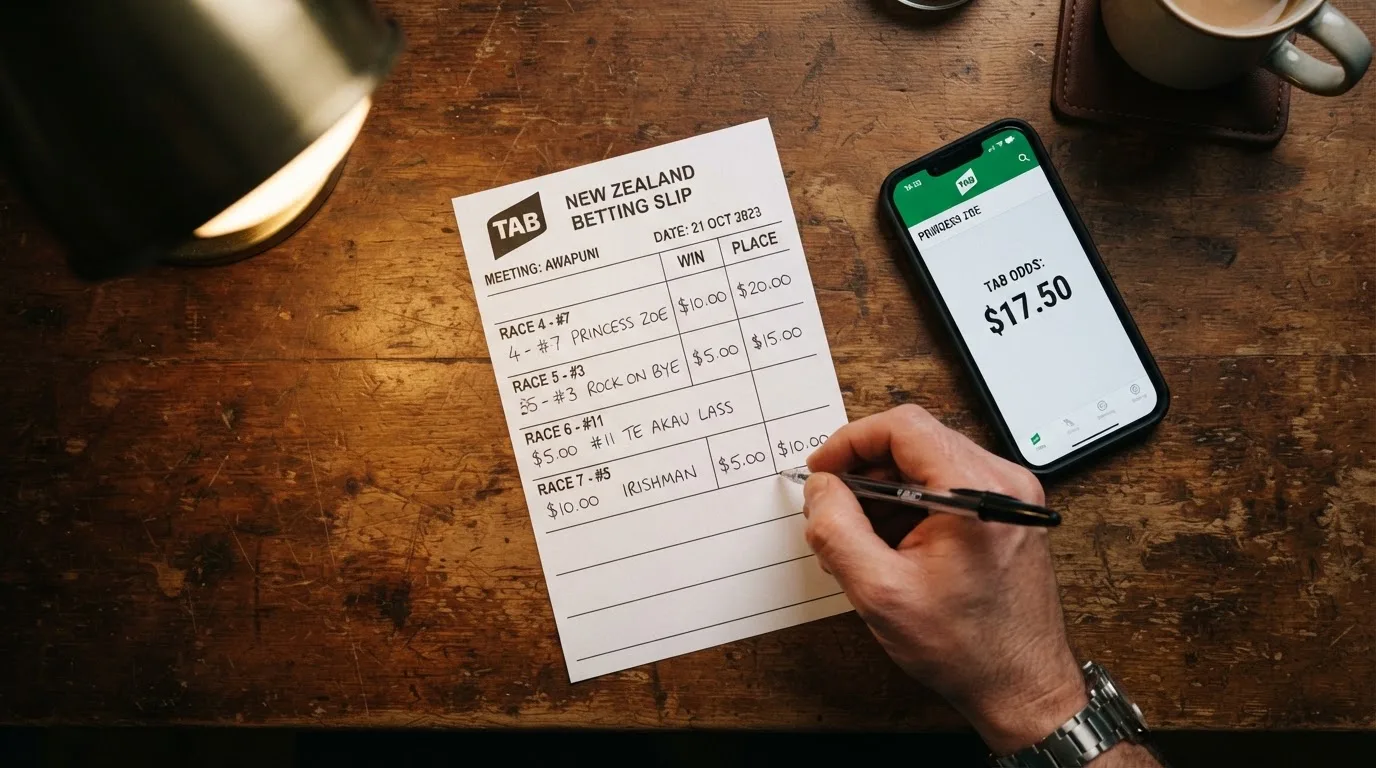
A worked example brings the tiers into focus. Take a $10 each-way bet on a 10/1 horse at 1/4 place terms with three places. The win part costs $10 and returns $110 if the horse wins (stake plus profit). The place part costs $10 and returns $35 (the $10 stake plus $25 profit at 1/4 of the win odds, rounded). Total stake: $20. Total return if the horse wins: $145. If the horse finishes second or third, only the place part pays: $35 on a $10 place stake, for a $25 net result after both stakes.
Exotic and pool bets
TAB NZ’s published betting rules list Quinella, Exacta, Trifecta, First Four, Double, Treble, Daily Double, Running Double, Quaddie and Big6. The Quinella picks the first two finishers in any order. The Exacta picks the first two in correct order. The Trifecta and First Four extend the pattern to three and four runners respectively. The Double and Treble roll selections across consecutive races; the Daily Double resets the leg set each meeting. The Quaddie asks for four nominated races at one meeting, and Big6 extends the pattern to six.
Pool bets pay a dividend declared after the race rather than a fixed price struck at bet time. The dividend reflects the pool size and the number of winning tickets, so the return on a $5 Trifecta can swing from a few dollars into five figures depending on how many punters landed the same combination. Tote bets and fixed-odds bets sit in the same TAB NZ wallet, but the pricing logic is different: fixed odds are the bookmaker’s price at the moment of the bet; tote dividends are the market’s.
Odds formats and what decimal odds mean
TAB NZ shows prices in decimal form by default. A $10 bet at $2.10 returns $21 — the $10 stake plus $11 profit — if it wins. The decimal price is the multiplier on the stake. A price of $5.00 returns five times the stake, $4.00 returns four times, and $1.50 returns 1.5 times. Decimal odds below $2.00 indicate a favourite: a $1.50 winner is a heavy favourite. Decimal odds above $5.00 indicate an outsider.
New Zealand’s tote dividend language differs. A tote dividend of $3.40 means the same thing as fixed odds of $3.40 — the dividend is the per-dollar return, not the profit. Punters who switch between fixed-odds and pool bets keep that distinction in mind: a tote dividend of $2.10 is the return, not the profit margin.
The margin inside every market
Every price a bookmaker or tote publishes carries a margin — the cut the operator keeps of every dollar bet on the market. The margin is invisible in any single price but visible across the field. A fair two-horse market with no margin prices each runner at $2.00 exactly, returning the full dollar to bettors on the winning side once payouts balance. Real markets price below $2.00 on both sides because the prices are reciprocal, and the gap between the two prices and the $2.00 fair line is the margin.
An illustrative calculation makes the mechanic concrete. Suppose a two-way market (the kind of binary bet a tennis match or a head-to-head offers) is priced at $1.90 on each outcome. The payout share of that market — what returns to bettors in aggregate — is 1 ÷ (1/1.90 + 1/1.90) = 1 ÷ (0.5263 + 0.5263) = 1 ÷ 1.0526 = 0.9500. The margin is 1 − 0.9500 = 0.0500, or roughly 5%. That 5% is what the operator keeps on every dollar bet on this market in the long run. A more competitive market at $1.95/$1.95 has a payout share closer to 0.975 and a margin of about 2.5%. A rounder at $1.80/$1.80 has a payout share of about 0.9000 and a margin of roughly 10%.
The range matters more than any single number. A market with a 5% margin and a market with a 2.5% margin look almost identical on the price board, but across a season of betting the difference compounds. A punter placing $1,000 of bets on a 5% margin market expects to pay the operator $50 in edge; on a 2.5% margin market the same volume costs $25. The arithmetic is mechanical, and it is the reason sharp bettors shop the field for the smallest margin.
Races, Codes, and What the Calendar Looks Like
New Zealand’s racing calendar runs on three codes — thoroughbred, harness, and greyhound — with thoroughbred and harness carrying the deepest pools. The third code is closing: TAB NZ has wound greyhound racing down in stages, with the final meeting set for 1 August 2026, after which no licensed operator may take bets on greyhound racing in New Zealand.
Flat, jump, and the codes in play
Horse racing divides into flat racing and jump racing. Flat racing is run directly between two points on a straight or oval track. Jump racing — steeplechasing and hurdling — is referred to as National Hunt racing in Great Britain and Ireland. New Zealand’s thoroughbred calendar is overwhelmingly flat, with steeplechase and hurdle races a smaller segment of the programme.
Flat races range in distance from roughly 400 metres to over six kilometres, with one to two and a half kilometres the most common distances on the New Zealand programme. Sprint races run under a minute; staying races over middle distances run closer to three minutes; the longest flat races push past that and reward stamina over speed.
Handicaps and conditions
In handicap races each horse carries a different weight, set by the handicapper based on the horse’s assessed ability, with the better horses carrying more weight to level the field. Conditions races, by contrast, give horses the same weight with allowances — typically weight concessions for younger horses, for female horses racing against males, or for horses that have not previously won. New Zealand handicaps sit at the heart of the midweek programme; conditions races anchor the Saturday features.
Tournaments and the Australian connection
New Zealand’s racing calendar interlocks with Australia’s. The Melbourne Cup in November is the single largest betting event of the southern-hemisphere spring; New Zealand-bred horses regularly contest the major Australian races. The Sydney spring features, the Cox Plate, and Melbourne’s autumn classics all carry weight on TAB NZ’s fixed-odds boards, and pool bets on those races draw some of the deepest dividends of the year.
In the northern hemisphere, the British Triple Crown — the 2000 Guineas, the Derby, and the St Leger — anchors the classics; the American Triple Crown and the major French and Irish races round out the international programme TAB NZ takes bets on. New Zealand punters with an account at TAB NZ or Betcha can bet into those pools and fixed-odds markets; the same offshore brands that offer global racing coverage are not licensed to take those bets from New Zealand residents.
How a Bet Is Placed, Step by Step
The mechanics of placing a horse racing bet are simpler than the markets suggest. The hard part is choosing what to bet on, not how to send the bet.
Account, identity, and the 18+ rule
TAB NZ requires a verified New Zealand address and ID to open an account. The minimum age for betting is 18; the App Store listing carries a 17+ rating for the app, but the operator’s own terms make clear that customers must be 18 or over to bet. Betting under 18 is an offence under section 89 of the Racing Industry Act 2020. Land-based casino age is 20 — a different threshold — and the two must not be conflated.
Account opening asks for a name, a New Zealand residential address, and proof of identity. Once verified, the account carries the punter’s details across both TAB NZ brands — TAB and Betcha — so a self-exclusion on one applies across both.
Picking the race and the market
The TAB NZ platform lists the day’s meetings by code. A thoroughbred meeting opens a card listing each race, the runners, the saddlecloth numbers, the barrier draw, the jockey and trainer, the horse’s recent form, and the going. Selecting a race opens the market types available for that race: win, place, each-way, Quinella, Exacta, Trifecta, First Four, Quaddie, Big6, and the multi bet options across races.
A punter who has decided on a runner enters the stake on the win market, the place market, or the each-way market. A punter building a multi picks two or more legs and watches the combined odds update as each leg is added.
Sending the bet and the bet slip
The bet slip confirms the selection, the market type, the stake, and the potential return. Once the bet is confirmed, the stake is debited from the wallet and the bet is recorded. Pool bets — Quaddie, Big6, Trifecta, Exacta — settle after the running of the relevant race or meeting; fixed-odds bets settle as soon as the official result is recorded.
The TAB NZ app includes Trackside live race streaming with in-app betting, so a punter watching a race can place a bet mid-race on the next leg of a multi. The same wallet that funds the bet holds the payout; no separate withdrawal step is required for settled bets.
Payouts and the timing of settlement
A winning win or place bet pays out to the wallet as soon as the official result is recorded. Pool bets — Quaddie, Big6, Trifecta, Exacta, First Four — pay out once the dividend is declared. Tote dividends are declared after the running of the relevant race, with a settling window that varies by meeting and pool.
TAB NZ publishes its deposit methods, payout times, and limits in its terms. The page carries no opinion on the right method for a given punter — that decision turns on the punter’s bank, the method’s fees, and the payout time the punter can tolerate.
The Ten Brands on the Board — and What Sets Each Apart
The New Zealand racing and sports betting market is closed. Since 28 June 2025 only TAB NZ and its online sister Betcha may lawfully take racing or sports bets from a person in New Zealand. The brands below are listed for reference because New Zealand punters meet them in advertising, in affiliate content, and in conversations about offshore racing — and because the comparison has value when a punter is deciding whether to look past the local monopoly.
TAB and Betcha are not rivals. They are the two online brands of TAB NZ, run by Entain under a 25-year agreement signed in 2023. TAB NZ is the heritage brand; Betcha is the newer, app-led brand built around a streamlined wallet and a younger product surface. They share the same odds feed, the same betting rules, and the same harm-minimisation framework. The brands listed after them carry no New Zealand licence and may not lawfully take bets from people in New Zealand; their inclusion on this page is for comparison, not as a recommendation.
TAB
TAB is the older of the two TAB NZ brands, the one that New Zealand punters have used at the pub, the track, and the website for decades. The platform covers thoroughbred, harness, and greyhound racing — with greyhound racing winding down to a close on 1 August 2026 — alongside the major sports codes: rugby union, rugby league, cricket, basketball, and the international sports an account holder wants to bet on. The TAB brand carries the heritage betting rules: Win, Place, Each Way, Quinella, Exacta, Trifecta, First Four, Double, Treble, Daily Double, Running Double, Quaddie, and Big6, plus Multis and Same Game Multis.
The TAB app lists deposit limits, time-outs, and self-exclusion as standard safer-gambling tools, and points to the free Gambling Helpline (0800 654 655, text 8006) for anyone who needs support. A self-exclusion applies across TAB NZ’s brands. The wallet is the same wallet that powers Betcha, and a punter’s exclusions, deposit limits, and identity checks carry over.
The TAB brand is the natural choice for a punter who wants the deepest pool coverage, the heritage betting rules, and the longest track record of operating under the New Zealand framework. The drawback is product polish — the heritage platform is built on a long code base and a long product history, and the user experience is functional rather than slick.
Betcha
Betcha is the newer TAB NZ brand, first released on 6 August 2024 and published on the New Zealand App Store by Entain New Zealand Limited. The product surface is built around a simplified wallet, a clean bet slip, and a younger design language. The platform covers the same racing and sports as TAB, with the same odds feed and the same betting rules, but the app-led approach and the streamlined wallet are the points of difference.
Betcha is the natural choice for a punter who wants the same New Zealand framework as TAB in a more modern product. The drawback is that some legacy features — long-form form analysis, certain exotic pool bet displays — sit more comfortably on the TAB brand.
Rooster.bet
Rooster.bet is not licensed in New Zealand. Only TAB NZ may offer racing and sports betting to people in New Zealand under section 74AAA of the Racing Industry Act 2020. Rooster.bet names a Tobique Gaming Commission e-gaming licence (No. 0000002), held by Novatrix SRL — a Canadian First Nations licensing regime that holds no permit for New Zealand. No New Zealand complaints route or harm-minimisation framework applies.
The brand’s sportsbook carries Live, Sports Promotions, Results, Schedule, E-sports and Predictions sections, with odds shown in six formats. Rooster.bet has no presence in New Zealand and no path to one under the current law.
Golden Panda
Golden Panda is not licensed in New Zealand. The brand lacks local licensing, and the offshore framework behind it is unauthorised here. The brand also lacks New Zealand harm-minimisation tools and a local complaints route.
The brand offers a Sports section with a sportsbook, esports and virtual sports, alongside casino, live casino, crash games, rewards, cashback, a VIP Club, Golden Goals and Prediction Markets. The casino weight of the product is heavier than the sportsbook — a profile that reflects the brand’s offshore positioning rather than a serious racing offering.
BetNinja
BetNinja is not licensed in New Zealand. The Union of the Comoros licence the brand cites carries no local standing. The brand lacks New Zealand harm-minimisation tools and a local complaints route.
BetNinja advertises a casino welcome of EUR 1,000 bonus and 100 free spins, alongside a sports offer of a 100% match up to EUR 100 on the first deposit. The product is offshore-curious rather than New Zealand-aware, and the brand’s racing coverage is incidental.
BetAlright
BetAlright is not licensed in New Zealand.
BetAlright’s sportsbook covers football, tennis, table tennis, basketball, ice hockey, American football and baseball, with Live Betting and Virtual Sports sections. Horse racing is not a primary line — the brand’s weight sits with the major team sports and the live product.
FunBet
FunBet is not licensed in New Zealand.
FunBet’s sportsbook offers odds on football, ice hockey, American football, basketball, volleyball, tennis, rugby and baseball, with live betting and a 24/7 bookmaker. The product surface is broad and live-leaning; horse racing is not the centrepiece.
Spinbara
Spinbara is not licensed in New Zealand. It holds no New Zealand licence, and the offshore framework behind it is unauthorised here. The brand lacks New Zealand harm-minimisation tools and a local complaints route.
Spinbara advertises a first deposit bonus of 100% up to EUR 100 and a sport crypto welcome bonus of 100% up to 200 USDT on its English site, alongside a casino welcome bonus of 100% up to EUR 500 plus 200 free spins. The product surface is split roughly evenly between the two games, with the bonus structure weighted toward casino players.
22Bet
22Bet is not licensed in New Zealand. The brand names a Curaçao licence (8048/JAZ), held by TechSolutions Group N.V., which carries no local standing.
22Bet offers over thirty market types per event, including 1X2, Double Chance, totals, both teams to score, correct score and HT-FT for football, plus tennis game, set and handicap markets. The market depth is a genuine strength on football and tennis — and irrelevant in New Zealand, where the law prohibits 22Bet from taking bets on those markets from New Zealand residents.
Telbet
Telbet is not licensed in New Zealand. The brand names no licence that applies in New Zealand, and the offshore framework behind it is unauthorised here.
Telbet describes itself as a crypto casino and sportsbook, with a welcome offer of 200% up to 1 BTC plus 50 free spins and a 5 USDT free bet on its Russian-language site. The product surface is crypto-weighted, and the New Zealand framework does not reach it.
What the brand comparison actually settles
The comparison’s conclusion is short. TAB and Betcha are the only two brands on this page that may lawfully take horse racing bets from a person in New Zealand. The other eight brands cannot. A punter who wants to bet on horses inside the New Zealand framework has, today, the choice between TAB and Betcha — two products on the same odds feed, the same wallet, and the same harm-minimisation tools, differentiated by product surface. A punter who wants to bet on horses through an offshore brand steps outside the framework the law has set up, and the Department of Internal Affairs has stated the risks of doing so.
The Legal Frame Around the Bet
The legal structure sits behind every account, every deposit, and every bet placed through TAB NZ. The structure is the reason the market looks the way it does — one operator, two brands, no licence register for bookmakers.
The Racing Industry Act 2020 and the 2025 amendment
The Racing Industry Act 2020 establishes TAB NZ as the racing and sports betting provider for New Zealand. The Racing Industry Amendment Act 2025 inserted section 74AAA: no person other than TAB NZ may offer racing betting, sports betting, or other racing or sports betting to a person in New Zealand, regardless of where that person is resident or incorporated. The change took effect on 28 June 2025, and the Department of Internal Affairs told providers serving New Zealand to withdraw with immediate effect.
The law targets the operator, not the player. Section 19(4) of the Gambling Act 2003 (inserted in 2025) says an individual may not be convicted for placing a bet with an offshore betting operator in breach of section 74AAA. No published penalty for a player was found. The penalty for an operator breaching section 74AAA is not stated in the section, and no prosecution of an offshore bookmaker has been published.
The Entain partnership and what it funds
TAB NZ’s partner Entain runs the TAB business under a 25-year agreement signed in 2023. The deal gives Entain a 50/50 share of gross profits, with at least $150m a year going to TAB NZ for the first five years, and Entain pledged a one-off $100m payment to the racing sector. The partnership is the commercial backstop of the New Zealand framework: the racing industry receives a guaranteed cut, Entain runs the technology and the trading, and TAB NZ operates as the licensed provider.
The Online Casino Gambling Act 2026
The Online Casino Gambling Act 2026 licenses online casino gambling in New Zealand. The Act is separate from the Racing Industry Act 2020. TAB New Zealand winning the right to apply for a casino licence under the 2026 Act does not extend the betting monopoly, and a casino licence is not a betting licence. The two regimes sit beside each other: betting under the Racing Industry Act, casino under the Online Casino Gambling Act 2026.
Greyhound racing closure
Greyhound racing is closing in stages, with the final meeting set for 1 August 2026. From that date offshore operators may not take bets on greyhound races either. The greyhound calendar has already shrunk; the thoroughbred and harness calendars continue.
Tax and the player’s winnings
For the player, Inland Revenue guidance says recreational gambling winnings are generally not taxable, and prize money from TAB horse, dog, and trotting races is not taxable. A person who bets as a business is a different case — general information, not tax advice, and the player can consult Inland Revenue or an accountant if their betting activity looks like a trade.
The player’s view of offshore betting
New Zealand does not block bookmaker sites. The Department of Internal Affairs warns that overseas operators may be in jurisdictions with minimal consumer safeguards, may not return unspent credits, and may not pay out large wins. A punter stepping outside the New Zealand framework loses the regulator, the complaints route, and the harm-minimisation tools that sit behind TAB NZ. The page does not invite that step; it describes it so the reader can decide with the trade in front of them.
Safer Gambling Tools and Where to Get Help
TAB NZ carries the safer-gambling apparatus that the law requires. The tools are the operator’s own, the helpline is independent, and the player chooses how to use them.
The deposit limit, time-out, and self-exclusion
The TAB NZ app provides deposit limits, time-outs, and self-exclusion. A deposit limit caps the amount a punter can deposit over a chosen window — daily, weekly, or monthly. A time-out suspends the account for a set period, from a few days to several months. A self-exclusion closes the account for a longer term, with a defined cooling-off period before the account can be reopened. The exclusions and limits apply across TAB NZ’s brands — TAB and Betcha share the same wallet and the same exclusion framework.
The Gambling Helpline and Safer Gambling Aotearoa
The free Gambling Helpline (0800 654 655, text 8006) and Safer Gambling Aotearoa are the front-line support services for anyone whose gambling has become harmful. The helpline is independent of TAB NZ and the regulator, and the contact details are listed in TAB NZ’s app. A punter who feels the betting has stopped being a choice can reach the helpline directly — without going through TAB NZ — and the call is free.
The Problem Gambling Levy
TAB NZ pays a Problem Gambling Levy of 0.74%, in force from 1 July 2025 to 30 June 2028. The levy funds harm-minimisation services across the gambling sector, including the Gambling Helpline and Safer Gambling Aotearoa. The levy is paid by the operator, not the player; it is part of the framework behind every TAB NZ bet.
A note on the offshore brands
The offshore brands on this page carry no New Zealand harm-minimisation framework. Their safer-gambling tools, where they exist, sit under their own licensing regime, and the Department of Internal Affairs’ warnings apply in full. The player’s recourse on a complaint is the brand’s own regulator, which may be in a jurisdiction with minimal consumer safeguards.
Bonuses and the Free-Bet Question
Bonuses exist on this page because New Zealand punters meet them in advertising and on the betting platforms. The framing is the same as on the rest of the article: TAB NZ runs bonus-bets promotions under its own terms; the offshore brands run their own bonus structures; and the arithmetic behind a bonus is what decides what the offer is actually worth.
What TAB NZ’s bonus-bet promotions look like
TAB NZ runs “bonus bets” promotions as part of its marketing. The structure is an operator-level decision; the Racing Industry Act 2020 sets no rule on bet-bonus size or wagering terms. A punter claiming a TAB NZ bonus-bet promotion reads the terms: the bonus-bet stake is usually not paid back with a win, the eligible markets are usually restricted, and the deadline for using the bonus is usually tight. The page carries no specific TAB NZ promotion; the structure is the point.
What a free-bet offer costs the player
A free-bet offer is a token that pays out the win at the bookmaker’s odds without refunding the stake. A $10 free bet on a $3.00 winner pays $20: the $10 stake is forfeited, the win is $20 profit. The arithmetic on the cost of a free bet runs through the market’s margin. A free-bet offer on a market with a 5% margin has a value of $10 × ($3.00 − 1) ÷ $3.00 × 0.95 = $10 × 0.667 × 0.95 ≈ $6.33. The same free bet on a market with a 2.5% margin has a value of $10 × 0.667 × 0.975 ≈ $6.50. A free-bet offer on a market with a 10% margin has a value of $10 × 0.667 × 0.90 ≈ $6.00.
The numbers carry the point. A free bet is worth the headline amount times a fraction, and the fraction swings with the market’s margin. A punter who wants to maximise the value of a free bet lays it on the lowest-margin market they can find — usually a win bet on a fancied runner — and skips the headline-grabbing markets where the margin is wider.
The offshore welcome bonuses
The offshore brands on this page carry their own welcome bonus structures. BetNinja advertises a 100% match up to EUR 100 on the first deposit for sports; Spinbara advertises a 100% match up to EUR 100 and a sport crypto welcome bonus of 100% up to 200 USDT; Telbet advertises a 200% match up to 1 BTC plus a 5 USDT free bet. The headline numbers are large. The terms — wagering factors, minimum odds, eligible markets, deadlines, caps on winnings — are where the cost lives. A punter reading any of these offers calculates the required turnover at the wagering factor, counts the number of bets at the punter’s stake, and looks for the minimum price that counts. A 100% match with a 10x wagering factor on the bonus plus deposit requires a turnover of 20x the bonus to clear, and at a $10 stake that is twenty bets at minimum price — a hundred dollars of betting before the bonus is paid out.
The bigger picture
A bonus is worth what it pays out, not what it advertises. The arithmetic is mechanical: turnover × margin is the expected cost; the bonus minus the expected cost is the expected value. A punter who treats the bonus as a free ticket is a punter who overpays for the privilege. The page does not score the specific offers; the structure is the point, and a sharp punter reads the terms.
The Mobile and App Picture
TAB NZ and Betcha are app-first products. The betting slip, the live streaming, and the wallet live on the phone. The rest of the market — the offshore brands — sit on browser platforms that may or may not have a mobile app; the mobile experience is not the centrepiece.
The TAB NZ app
The TAB – Racing & Sports Betting app is published on the New Zealand App Store under the seller name New Zealand Racing Board, first released on 8 September 2014. The app covers horse and harness racing, rugby union and rugby league, and other sports, pre-match and live. The 17+ App Store rating sits on the listing; the operator’s own terms make clear that customers must be 18 or over to bet. The app includes Trackside live race streaming with in-app betting, racing form, Blackbook and Jockey Challenge tools, and a simplified wallet for deposits and withdrawals.
The Betcha app
The betcha | Sports Betting app is published on the New Zealand App Store by Entain New Zealand Limited, first released on 6 August 2024. The product surface is built around the same betting rules and the same wallet as TAB, but the design language is newer and the wallet is more streamlined. The app is the natural choice for a punter who wants the same New Zealand framework as TAB in a more modern product.
The offshore apps
The offshore brands sit on browser platforms. Some carry mobile apps; some do not. The mobile experience is not the centrepiece of an offshore brand, and a punter who wants the best mobile experience in New Zealand is a punter who uses TAB or Betcha.
Live Betting, Cash Out, and In-Running
Live betting on horse racing is constrained by the race’s duration. A horse race runs for under a minute in a sprint and for three minutes or more in a staying race; the in-running window is short, and the markets that exist in-running are limited. TAB NZ lists live betting in its apps; the markets and the in-running product sit beside the pre-match offering.
What live betting on racing actually offers
A live horse race market is the same market on a tighter clock. The win market, the place market, and the exotics all settle at the end of the race; the in-running product on a horse race is mostly pre-race and at-the-jump pricing, with limited in-running updates after the start. A punter who wants a deep in-running product looks at football, tennis, and basketball rather than horse racing.
Cash out
Cash out is a feature on some bookmakers that lets a punter close a bet before the race is run, at a price set by the bookmaker at that moment. TAB NZ’s product surface includes cash-out features on selected markets; the page carries no specific market list, and the punter’s own TAB NZ account is the right place to check.
The broadcast and the bet slip
Trackside live race streaming with in-app betting is built into the TAB NZ apps. A punter watching the race on Trackside can place a bet mid-race on the next leg of a multi, settle a cash-out position, or read the form for the next race. The integrated product is the edge TAB NZ has over the offshore brands, which do not carry the same broadcast integration for New Zealand racing.
Predictions, Systems, and What Sharp Betting Looks Like
The “best bet today” framing is the wrong framing for horse racing. Horse racing is a market with a long memory and a deep information set; the edge a punter can find is small, and the markets price most of the available information into the odds before the bet is placed.
The shape of a prediction product
A prediction product for horse racing — a tipster sheet, a system, a model — is a structured way to generate selections. The quality of the product turns on the data the product uses, the way it weights that data, and the calibration of the output against the market. A product that picks more winners than the odds suggest is a product with edge; a product that picks winners at the rate the odds predict is a product without edge, and a punter paying for the product is paying for the noise.
The system that doesn’t beat the track
The most common system failures in horse racing are the same as in any other market. A system that picks favourites will win more often than it loses, and lose money in the long run because the favourite’s win rate is below the price the market offers. A system that picks longshots will lose more often than it wins, and lose money faster because the longshot’s win rate is well below the price the market offers. A system that finds the right balance — the value bet, the price that is higher than the horse’s true probability — is a system with edge, and such systems are rare.
What the punter can actually do
The punter’s practical edge runs through three routines. First, read the form: the horse’s recent runs, the going, the distance, the barrier draw, the jockey and trainer combination. Second, check the market’s price against the punter’s own price: if the punter’s price is higher than the market’s price, the bet has edge; if the market’s price is higher, the bet does not. Third, manage the bank: a fixed unit stake, a record of every bet, and a stop-loss when the bank is down. The routines are mechanical; the discipline is the harder part.
The honest ending
No system wins at horse racing in any predictable way. A punter who bets as a hobby treats the betting as the cost of entertainment and skips the systems. A punter who bets as a serious activity treats the betting as a market for information and accepts that the edge is small. The page carries no tipster sheet, no system, no model; the routines above are the standard and the routines are the work.
What the Reader Does Next
The page has walked through the bet types, the odds, the races, the legal frame, the safer-gambling tools, the bonuses, the apps, the live product, and the prediction question. The reader has a comparison table and ten brand write-ups above; the next step depends on what the reader wants from the page.
A reader who wants to bet on horse racing in New Zealand today has, in practice, the choice between TAB and Betcha. Both are TAB NZ brands, both carry the same odds feed and the same harm-minimisation tools, and the choice between them turns on the product surface. A reader who wants a deeper market on international racing — the Melbourne Cup, the British classics, the American Triple Crown — has the same two options; both brands cover the international programme. A reader who wants the lowest-margin market can compare the two brands on any given race, and the comparison usually runs close.
A reader who wants to bet on horses through an offshore brand steps outside the New Zealand framework. The Department of Internal Affairs has stated the risks; the page describes them so the reader can weigh them. These offshore brands lack a New Zealand harm-minimisation framework, a local complaints route, and the right to take bets from New Zealand residents. A punter who weighs those costs and decides to step outside anyway has the comparison the table provides; a punter who decides to stay inside has the TAB NZ brands.
The Comparison Table
The table below sets the ten brands on the same row pattern: the brand, the New Zealand status, and a line on what the operator’s own terms state on racing. TAB and Betcha are the only brands that may lawfully take racing bets from a person in New Zealand. The other eight are not licensed in New Zealand.
| Brand | New Zealand status | What the operator’s terms say about racing |
|---|---|---|
| TAB | TAB NZ brand — the only lawful racing and sports provider in New Zealand | Win, Place, Each Way, Quinella, Exacta, Trifecta, First Four, Double, Treble, Daily Double, Running Double, Quaddie, Big6, Multis and Same Game Multis |
| Betcha | TAB NZ brand — the only lawful racing and sports provider in New Zealand | Same betting rules as TAB, streamlined wallet, app-led product |
| Rooster.bet | Not licensed in New Zealand | Live, Sports Promotions, Results, Schedule, E-sports and Predictions; no New Zealand racing licence |
| Golden Panda | Not licensed in New Zealand | Sports section with sportsbook, esports and virtual sports; no New Zealand racing licence |
| BetNinja | Not licensed in New Zealand | Casino and sports welcome offers; no New Zealand racing licence |
| BetAlright | Not licensed in New Zealand | Football, tennis, basketball and others; no New Zealand racing licence |
| FunBet | Not licensed in New Zealand | Football, basketball, rugby and others, with 24/7 bookmaker; no New Zealand racing licence |
| Spinbara | Not licensed in New Zealand | Sports, crypto and casino welcome offers; no New Zealand racing licence |
| 22Bet | Not licensed in New Zealand | Over 30 market types per football and tennis event; no New Zealand racing licence |
| Telbet | Not licensed in New Zealand | Crypto casino and sportsbook, BTC welcome offer; no New Zealand racing licence |
The table’s row pattern is the same for every brand, and the column pattern is the same: brand, New Zealand status, and what the operator’s own terms state on the key’s subject. The eight offshore brands carry the same New Zealand status, and their terms statements reflect what each brand publishes.
Frequently Asked Questions
How do I bet on horse races?
Open a TAB NZ account through TAB or Betcha, verify your New Zealand address and ID, fund the wallet, and pick a race from the day’s card. Choose a market — win, place, each-way, Quinella, Exacta, Trifecta, First Four, Quaddie, Big6 — enter the stake, and confirm the bet on the bet slip. The bet settles once the official result is recorded, with pool bets paying out at the declared dividend.
How does horse betting work?
A horse race offers a set of runners and a set of odds. The win market pays out if your horse finishes first. The place market pays out if your horse finishes in the place positions, at a fraction of the win odds. The each-way market combines the two, doubling the stake. Exotic markets — Quinella, Exacta, Trifecta, First Four — ask for the first two, three, or four finishers in order. Pool bets — Quaddie, Big6 — pay a dividend declared after the race rather than a fixed price.
How do odds work with horse racing?
Decimal odds are the multiplier on the stake. A $10 bet at $2.10 returns $21 if it wins — the $10 stake plus $11 profit. Decimal odds below $2.00 indicate a favourite; odds above $5.00 indicate an outsider. Tote dividends are written the same way: a $3.40 dividend means $3.40 returned per $1 bet. Every price carries a margin, the cut the operator keeps on every dollar bet on the market.
Which bookmaker may lawfully take sports and racing bets in New Zealand?
TAB NZ and Betcha are the only two online brands that may lawfully take racing and sports bets from a person in New Zealand, under section 74AAA of the Racing Industry Act 2020, in force since 28 June 2025. TAB and Betcha are two brands of the same operator, run by Entain under a 25-year agreement signed in 2023. No other bookmaker may lawfully take bets from New Zealand residents, and the Department of Internal Affairs has told providers serving New Zealand to withdraw with immediate effect.
How is the return on a bet worked out from the stake and the odds?
Return = stake × decimal odds. Net profit = stake × (decimal odds − 1). A $10 bet at $3.50 returns $35, with $25 net profit. A combination bet multiplies the odds of each leg into one combined price, and the stake is multiplied by the combined odds. Pool bets settle at the declared dividend, not at a price struck at bet time.
What is the bookmaker’s margin and how can it be seen in the odds?
The margin is the cut the operator keeps of every dollar bet on a market. A two-way market priced at $1.90 on each outcome has a margin of roughly 5% — meaning the operator expects to keep 5 cents per dollar bet on the market in the long run. A market at $1.95 on each outcome has a margin closer to 2.5%; a market at $1.80 has a margin closer to 10%. The narrower the spread between the two prices and $2.00, the smaller the margin.
Racing – dogracingnz.com
Content created by the «dogracingnz.com» team
